
Not Every Cash Offer Comes From a Cash Buyer
Some offers come from a company that plans to buy your home itself. Others come from a company that plans to assign the contract to another investor. Both can work, as long as you know which one you're looking at. Here's how to tell the difference.
Already have questions about a contract you signed? Scroll down, or call or text us anytime at 678-679-0819. No pressure.
Two Ways an Investor Offer Can Work
Two different structures, two different sets of tradeoffs.

A Direct Cash Buyer
A direct cash buyer looks at your property and runs the numbers before making an offer: what it's likely worth once repaired, what those repairs will cost, and what it takes to hold and resell it. When a direct buyer makes an offer, it's generally saying, “We're prepared to buy this house ourselves.” That usually means fewer moving parts.
An Assignment (Wholesale) Deal
In an assignment, the company that signs the contract with you doesn't plan to be the final buyer. It offers its position in the contract to other investors, and one of them closes in its place, usually paying a fee for putting the opportunity together. Done well, this can produce a higher number than a single direct buyer can justify. The tradeoff is that it depends on an investor agreeing to those terms, so there are more steps before closing.
The Real Tradeoff: Price vs. Certainty
This isn't good versus bad. It's two different tools.

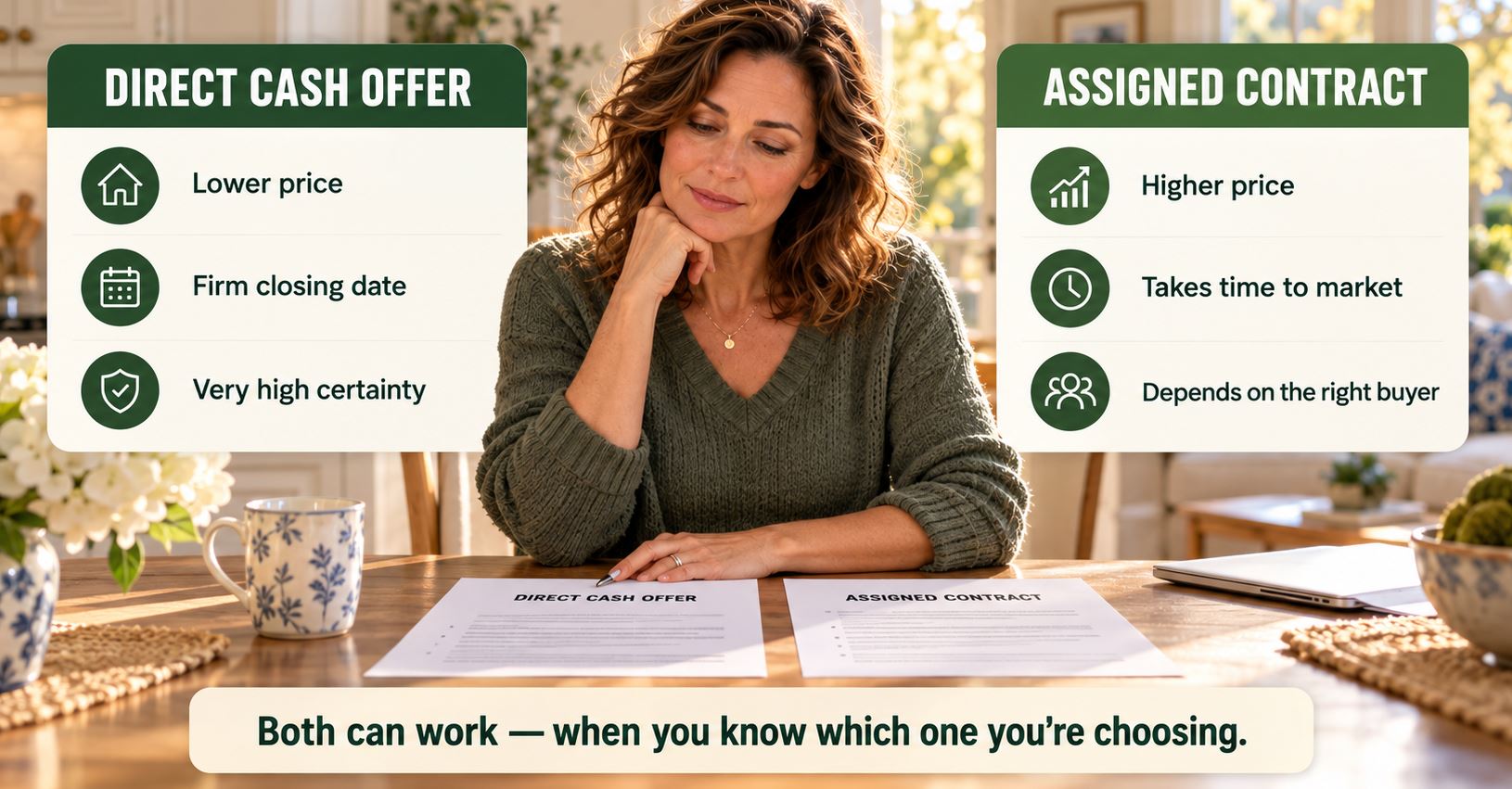
A direct cash offer usually means a more conservative number, a straightforward process and more certainty about closing. An assignment can open the door to a higher number by reaching a wider group of investors, but there are more moving parts before closing day.
Either one can be the right call. What matters is knowing which one you're signing up for, because the uncertainty lands on you. If you've already packed, put money down on your next home or told your landlord you're moving, a deal that changes in the final days isn't a minor inconvenience. It can be a real financial and emotional setback.
That's why the most important question isn't “Is this a wholesaler?” It's “Has anyone told me how this deal actually works?”
Wholesaling Isn't the Problem. Lack of Transparency Is.
Plenty of wholesalers do excellent work: upfront about their role, realistic about timelines and careful not to promise what they can't deliver. Plenty of direct buyers communicate poorly. The label isn't the issue. The issue is whether you were given a clear picture before you signed.
One of our team members once arrived at a scheduled appointment to find roughly twenty cars parked outside the seller's home. Walking up, he could hear the homeowner on the phone, visibly upset, asking why so many strangers had shown up to walk through her house without warning.
She had signed a contract that, buried in the fine print, gave the buyer the right to bring other investors through at any time with little notice.
The problem wasn't that her contract could be assigned. The problem was that nobody told her what that would look like.
(This is a composite, illustrative example based on situations we've seen, not a specific identified transaction.)
4 Questions to Ask Any Buyer — Including Us
Ask these of every company you talk to. Here's how we answer them.
1Whose Proof of Funds Am I Looking At?
Proof of funds tells you who is actually standing behind the offer, so ask whose it is.
How we handle it:
On a direct purchase, the proof of funds comes from us, the company buying your home. On an investor-partner deal, it comes from the investor who will be closing at the higher number, so you know exactly who's committing to it.
2Has the Earnest Money Actually Been Deposited?
An earnest money amount written into a contract isn't the same as money deposited with the closing attorney. Ask whether it will be deposited, and whether you'll get confirmation when it is.
How we handle it:
On a direct purchase, we deposit our earnest money with the closing attorney and send you their confirmation that it was received. On an investor-partner deal, how earnest money is handled is spelled out in writing before you sign.
3Who Will Be Walking Through My Home?
Some contracts allow other investors to tour the property, sometimes with little notice. Ask who will come, how many and how visits get scheduled.
How we handle it:
On a direct purchase, there are no buyer showings. At most, our contractor crew walks through to plan the work after closing. On an investor-partner deal, we narrow interest down to the three to five most serious, vetted investors and schedule those visits with you ahead of time.
4Will Anything Be Recorded Against My Property?
Some companies record the contract with the county. That can make it harder to sell to anyone else until it's formally released. Ask whether anything will be recorded, why, and how it gets released if the deal doesn't move forward.
How we handle it:
On investor-partner deals, we don't record the contract, so nothing slows down a sale if timing changes. On direct purchases, we may record a notice of our agreement. It protects both sides by keeping new loans or liens from being added before closing. Either way, you'll know before you sign.
Want the full breakdown? Read our companion articles: and .
A Slot Machine, or a Bird in Hand?
The difference isn't the path you choose. It's whether you know the odds.

The Slot Machine
Signing without knowing your contract may be assigned, how long they'll try or what happens if it doesn't work out is pulling a lever without knowing the odds. You find out how it lands at the very end, sometimes in closing week.
The Bird in Hand, Plus a Shot at More
When we've made you a direct offer, that offer is the bird in your hand. If you need a higher number, you can test for one over a set 10–14 day window, and our direct offer remains available while you do. If the higher number comes together, great. If it doesn't, you still have ours.
Most companies make you pick one path. With us, you can explore a higher number without letting go of the offer already in your hand.
Subject to the terms of your written agreement.
Two Ways We Can Help
We buy homes directly, and we also work with a network of 15,000 investors. Before you sign anything, we walk you through the pros and cons of each path so the choice is yours.
We Buy It Directly
We purchase your home ourselves, with our own funds.
- Proof of funds comes straight from us
- Earnest money is deposited with the closing attorney, and you get their confirmation
- No buyer showings; at most, our contractor crew walks through
- Fewest moving parts, with a clear path to closing
Best for: Sellers who want certainty, simplicity and speed.
We Partner With an Investor
Sometimes a seller needs a higher number than we can offer directly, for example to cover a mortgage payoff or liens. When that happens, we can offer our position in the contract to a short list of serious investors from our network who may want to close in our place or partner with us on the purchase.
- We go over the pros and cons with you first, honestly
- We prepare a clear summary of the opportunity so investors can evaluate it quickly
- Only three to five of the most serious, vetted investors view the property, scheduled with you in advance
- Proof of funds comes from the investor who will close at the higher number
- We don't record the contract
- You'll know within 10–14 days whether there's interest at your number
Honest tradeoffs:
- It takes 10–14 days to find out, instead of knowing right away
- A few scheduled visits to your home
- Not every number will find an investor partner
Best for: Sellers who need a specific number and are comfortable with a short window of more moving parts.
Why sellers like having both
If investor partners make written offers during the window, we review them with you and talk through any adjustments.
If the higher number doesn't come together, you can take our direct offer when we've made one, or we release the contract with no strings attached.
Either way, you'll know where you stand, and you won't be left guessing.
Availability of a direct offer depends on the property and is subject to the terms of your written agreement.
What to Look For
How a deal without transparency compares with our two paths.
| What to Look For | A Deal Without Transparency | Springwood: Direct Purchase | Springwood: Investor Partner |
|---|---|---|---|
| Told which path upfront? | Not always | Yes | Yes, in writing before you sign |
| Who closes | Often unclear until late | Springwood | A vetted investor from our network, or Springwood with a partner |
| Proof of funds | Sometimes vague | From Springwood | From the investor closing at the higher number |
| Earnest money | May be listed but never deposited | Deposited with the closing attorney; confirmation sent to you | Handling spelled out in writing before you sign |
| Visits to your home | Can be frequent or unannounced | None (at most, our contractor crew) | 3–5 vetted investors, scheduled with you |
| Recording | May be recorded and slow a sale | May record a notice to protect both sides; disclosed upfront | Not recorded |
| How long until you know | Sometimes not until closing week | Right away | 10–14 days |
| If it doesn't come together | Can fall apart late | Not applicable | Our direct offer (when made) remains available, or release with no strings |
Already Signed Something? Have Questions About a Contract You're Looking At?
If you've already signed a contract with another company — or you're looking at one and something doesn't feel right — we're happy to look it over with you and point out anything worth asking about.
One important note: Springwood Property Investors is not a law firm, and nothing we share is legal advice. We're not reviewing your contract to tell you whether to sign it or walk away — that's a decision for you (and, if you want full certainty, a licensed real estate attorney) to make. What we can do is point out the kinds of terms covered on this page — proof of funds, earnest money, access rights, title language — so you know what questions to ask.
Tell Us the Number You Need
We'll look at the real numbers and tell you honestly which path can get you there: a direct cash offer, a chance at a higher number through an investor partner, or both. No games, no surprises in your driveway, no pressure.
Or call or text us at 678-679-0819•No pressure, no obligation.