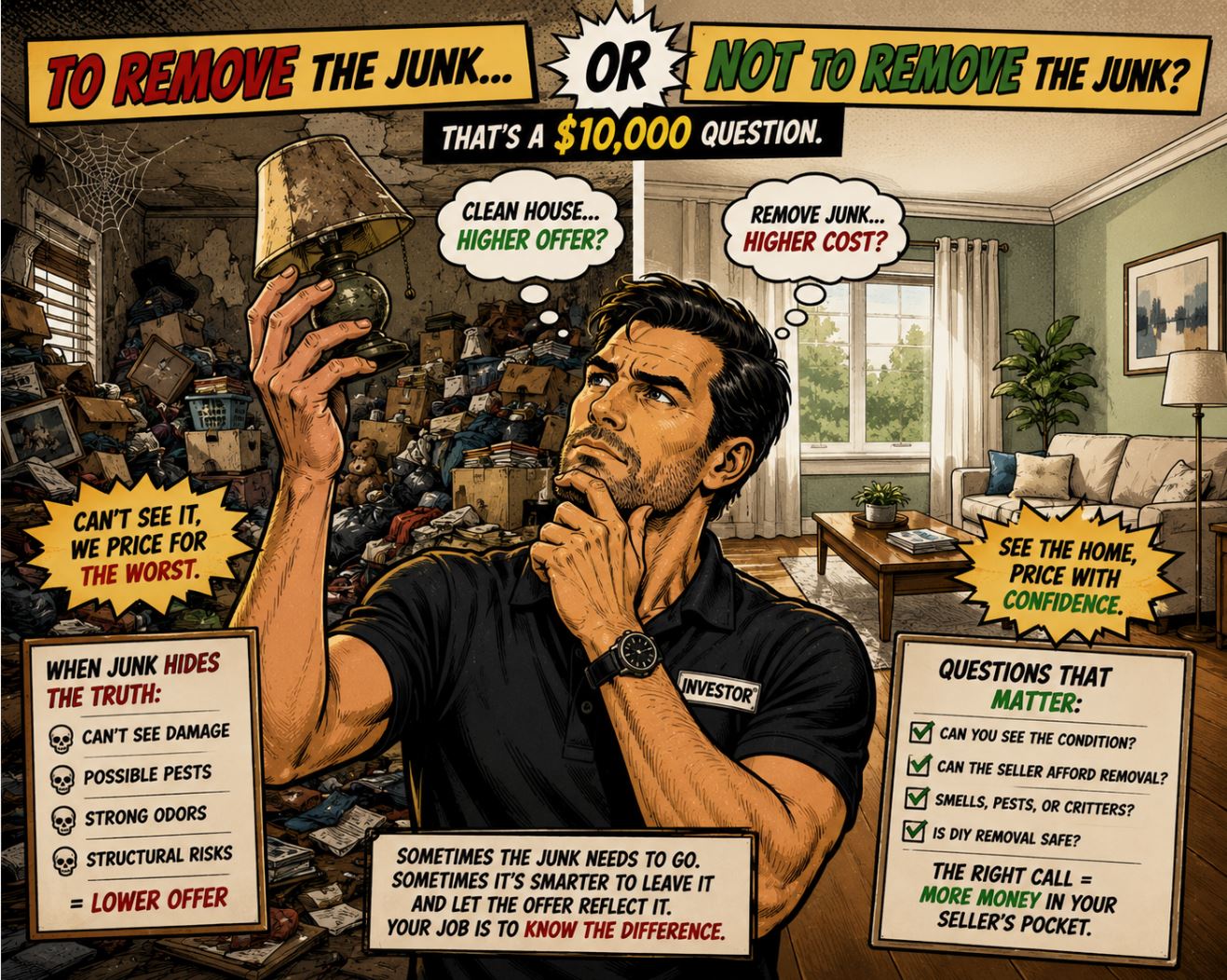
It's a fair question, and the honest answer is: it depends. Not on whether clutter looks bad — it usually does — but on what kind of clutter it is, what it's hiding, and whether your seller can actually afford to deal with it.
There's a difference between 'cluttered' and 'concealed.' If a house is full of stuff but you can still see the walls, feel the floor underneath you, and there's no overwhelming smell, that's clutter we can price around. We can still get eyes on the condition of the property, which means we can give a number with real confidence behind it.
It's a different situation when the clutter crosses into concealment — floor-to-ceiling piles you can't walk through, strong odors, spider webs, signs of pests or critters living in it. At that point, we're not looking at a messy house anymore. We're looking at a mystery, because we genuinely can't see what's underneath: water damage, subfloor rot, structural issues, you name it. When we can't see it, we have to price for the worst reasonable case — which means the offer comes in lower to account for what's hiding, not because we're trying to lowball the seller.
So does a clean house always get more money? Not automatically. Yes, a decluttered property shows better and removes some of the guesswork on our end. But junk removal isn't free — depending on volume, it can run $6,000 to $10,000 through a standard removal service, often more than what an investor's own crew can clear it for. If your seller doesn't have the cash to pay for removal upfront, forcing that step can cost more than it earns back. In that situation, leaving the junk and letting the investor factor it into the offer isn't a penalty — it's a convenience the seller is effectively paying for, instead of fronting money they don't have.
There's also a real liability angle worth mentioning to your seller. When homeowners try to clear it themselves — usually with friends or family helping out — that's exactly when people get hurt. Wrong lift, wrong bag, a sharp object buried in a pile nobody expected. Unless the clutter is genuinely light and easy to sort through, it's often safer (and cheaper in the long run) to leave it for professionals who know how to handle it, rather than risk an injury trying to save money.
The real questions worth asking before recommending a cleanout:
Can you actually see the condition of the property, or is the clutter hiding it?
Does your seller have the budget to pay for removal, or would it be a financial stretch?
Is there a smell, pests, or signs of things living in the pile?
Is DIY removal actually safe here, or is professional removal worth the cost?
Sometimes the junk needs to go. Sometimes it's smarter — and cheaper for your seller — to leave it exactly where it is and let the offer reflect it.